Blade Runner (1982)
Where to Watch
- To accurately portray their role in Blade Runner, Harrison Ford spent weeks conducting hands-on research and rehearsing directly with director Ridley Scott.
- Blade Runner utilized mostly practical sets and locations to ground the story, a specific choice insisted upon by Ridley Scott.
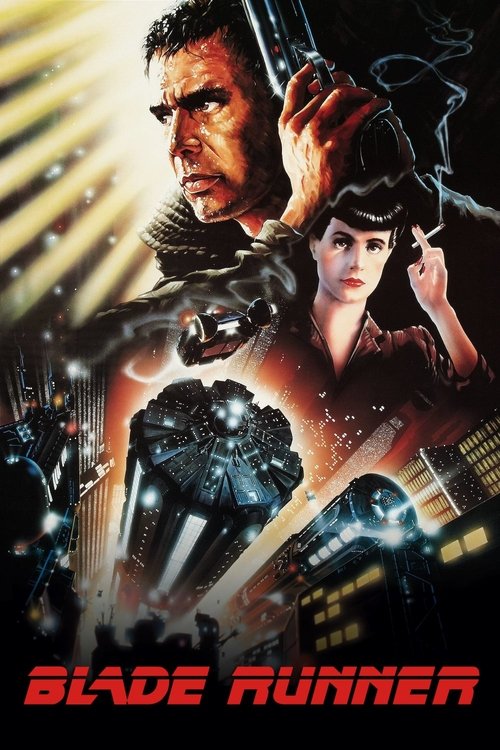
Blade Runner is a 1982 American science fiction film directed by Ridley Scott, loosely based on Philip K. Dick's 1968 novel "Do Androids Dream of Electric Sheep?" Set in a dystopian Los Angeles in November 2019, the film follows Rick Deckard, a retired "blade runner" played by Harrison Ford, who is coerced back into service to hunt down and "retire" four escaped replicants — bioengineered beings virtually indistinguishable from humans — who have returned to Earth seeking a way to extend their artificially limited four-year lifespans. Led by the formidable Roy Batty, played by Rutger Hauer, the replicants' quest to confront their creator and extend their existence becomes a meditation on mortality, consciousness, and what it means to be human.
Blade Runner was a commercial disappointment upon its original release, earning $41 million against a $28 million budget, and received mixed reviews from critics who found its pace slow and its narrative opaque. Over the following decades, however, the film underwent one of cinema's most dramatic critical reappraisals, eventually being recognized as one of the greatest and most influential science fiction films ever made. The film exists in seven known versions, the most significant being the 1992 Director's Cut and the 2007 Final Cut, which removed the studio-mandated voiceover narration and happy ending that Scott had never wanted.
Rutger Hauer's dying monologue as Roy Batty — "I've seen things you people wouldn't believe" — which the actor partly improvised on set, is considered one of the most poignant moments in cinema history. Syd Mead's production design and Jordan Cronenweth's cinematography created a vision of a rain-drenched, neon-lit future megacity that has influenced virtually every depiction of urban dystopia in the four decades since. Vangelis's synthesizer score became iconic in its own right.