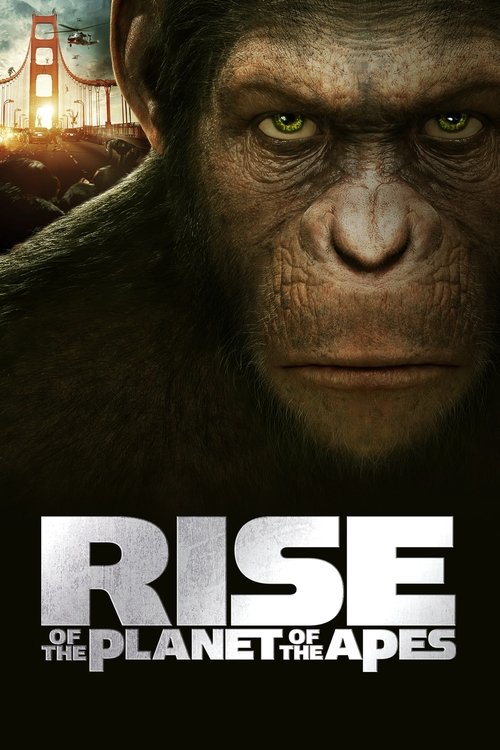
Rise of the Planet of the Apes (2011)
Where to Watch
- The original script for Rise of the Planet of the Apes was written over a decade before production finally began in 2011.
- Before Andy Serkis was cast, several major A-list stars turned down the lead role because they felt the script was too risky.
- The incredible score for Rise of the Planet of the Apes was composed in just a few weeks after the original composer dropped out.
Rise of the Planet of the Apes is a 2011 American science fiction film directed by Rupert Wyatt, a reboot of the Planet of the Apes franchise that tells the origin story of how apes gained the intelligence to overthrow human civilization. James Franco stars as Dr. Will Rodman, a scientist at a San Francisco pharmaceutical company who develops a genetically engineered virus intended to cure Alzheimer's disease.
When tested on chimpanzees, the virus dramatically enhances their cognitive abilities, and Caesar — a chimp raised by Will from birth — develops human-level intelligence, self-awareness, and eventually the leadership skills to organize a revolt against human captivity. Andy Serkis's performance as Caesar, realized through WETA Digital's performance-capture technology, was the film's groundbreaking achievement and one of the most significant advances in digital character creation since Gollum in The Lord of the Rings. Serkis brought extraordinary emotional depth and physical nuance to Caesar, creating a character whose journey from innocent infant to revolutionary leader was entirely conveyed through movement, facial expression, and occasional sign language rather than dialogue.
The film's climactic sequence on the Golden Gate Bridge, in which Caesar leads his ape army across the fog-shrouded span while battling police, was a spectacular set piece that demonstrated the potential of performance-capture technology for large-scale action filmmaking. Rise earned $481 million worldwide on a $93 million budget and earned widespread critical acclaim for revitalizing a franchise that had been considered dormant.