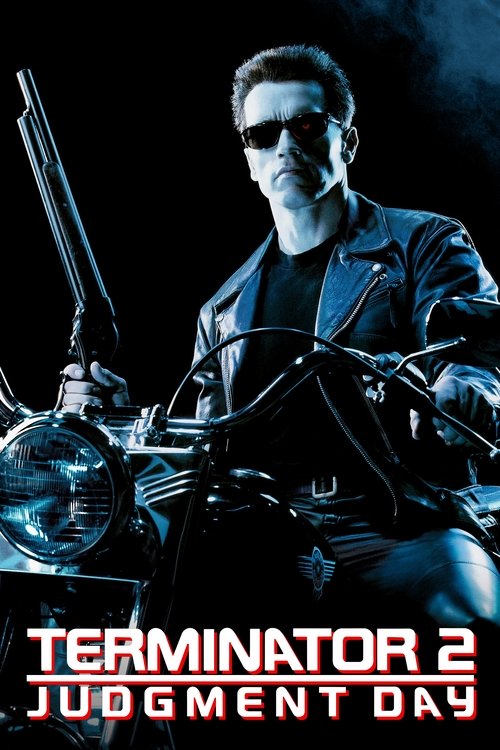
Terminator 2: Judgment Day (1991)
- To accurately portray their role in Terminator 2: Judgment Day, Arnold Schwarzenegger spent weeks conducting hands-on research and rehearsing directly with director James Cameron.
- Terminator 2: Judgment Day utilized mostly practical sets and locations to ground the story, a specific choice insisted upon by James Cameron.
Terminator 2: Judgment Day is a 1991 American science fiction action film directed by James Cameron, widely regarded as one of the greatest sequels and action films ever made. The film follows a young John Connor, the future leader of the human resistance, who is protected by a reprogrammed Terminator, the T-800 played by Arnold Schwarzenegger, sent back from the future to defend him against the T-1000, an advanced liquid-metal terminator played by Robert Patrick. The T-1000's ability to shapeshift, pass through solid objects, and reform after being destroyed made it one of the most terrifying and visually groundbreaking villains in cinema history.
Terminator 2 was a landmark in visual effects, pioneering the photorealistic computer-generated imagery that would transform the film industry. Industrial Light & Magic's work on the T-1000, which seamlessly morphed between Robert Patrick's human form and various liquid-metal configurations, required the development of entirely new software tools. The film's practical effects were equally impressive, with Stan Winston's animatronic T-800 endoskeletons and the spectacular real helicopter-under-an-overpass stunt setting new standards for practical action filmmaking.
Arnold Schwarzenegger's transformation from villain in the original film to protector in the sequel allowed him to bring unexpected warmth to the character, particularly in his relationship with young John Connor, played by Edward Furlong. Linda Hamilton's transformation into the battle-hardened, psychologically damaged Sarah Connor was one of the most striking character evolutions in sequel history. Terminator 2 earned $520 million worldwide on a then-record $102 million budget and won four Academy Awards for its technical achievements.