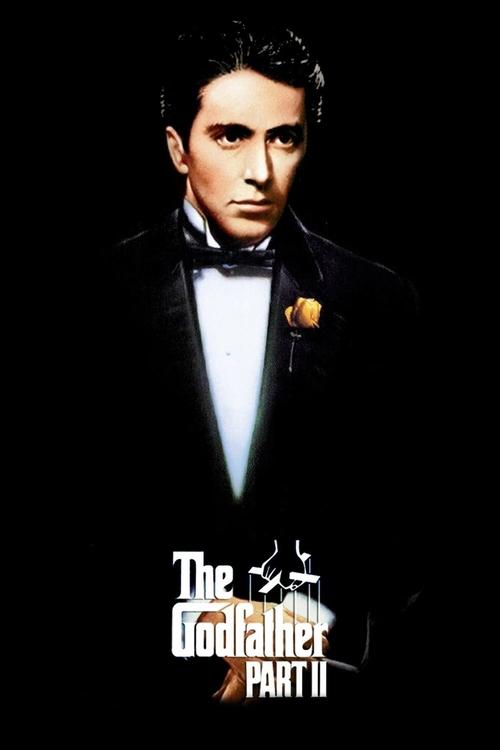
The Godfather Part II (1974)
- To accurately portray their role in The Godfather Part II, Al Pacino spent weeks conducting hands-on research and rehearsing directly with director Francis Ford Coppola.
- Despite initial studio skepticism, The Godfather Part II went on to gross over $93,000,000 worldwide.
The Godfather Part II is a 1974 American epic crime film directed by Francis Ford Coppola, both a sequel to and prequel of the 1972 original. The film interweaves two parallel timelines: in the present, Michael Corleone, played by Al Pacino, consolidates his control over the family's criminal empire while dealing with threats from rival families, a Senate investigation, and the gradual disintegration of his marriage and family relationships; in the past, the young Vito Corleone, played by Robert De Niro, emigrates from Sicily to New York at the turn of the century and rises from impoverished immigrant to the respected Don of a criminal empire through a combination of strategic violence, personal loyalty, and community service. The Godfather Part II is widely considered the greatest sequel in cinema history and one of the greatest films ever made, frequently debated alongside its predecessor as the superior work.
Robert De Niro won the Academy Award for Best Supporting Actor for his portrayal of the young Vito — remarkably, he spoke almost entirely in Sicilian dialect, a language he learned specifically for the role. The film won six Academy Awards, including Best Picture and Best Director, making Coppola the first director to win consecutive Best Picture awards. The dual-timeline structure was revolutionary, using Vito's rise to ironic counterpoint against Michael's moral descent — as the father builds a family through community and honor, the son destroys his family through paranoia and cold-blooded pragmatism.
Al Pacino's controlled, increasingly ruthless Michael Corleone remains one of the most chilling portrayals of moral corruption in cinema. The film earned $47 million domestically and has been preserved in the National Film Registry.