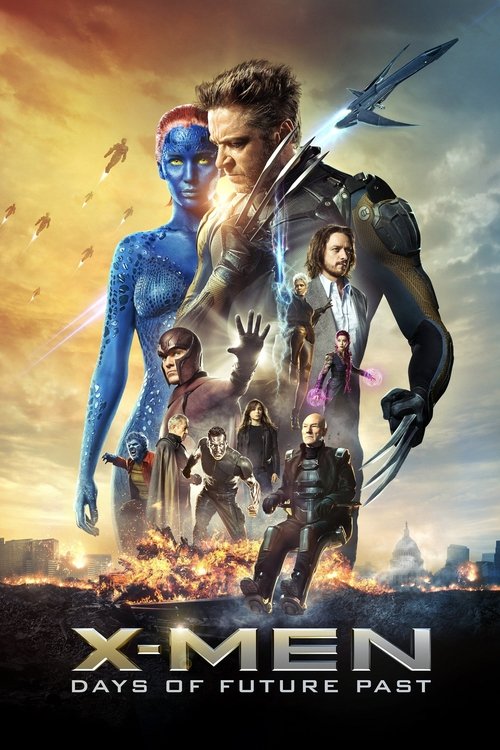
X-Men: Days of Future Past (2014)
- Eagle-eyed viewers have noticed a hidden easter egg referencing Bryan Singer's previous film in the background of the opening scene.
- The incredible score for X-Men: Days of Future Past was composed in just a few weeks after the original composer dropped out.
- Bryan Singer originally wanted a completely different ending for the film, but test audiences preferred the one we see today.
X-Men: Days of Future Past is a 2014 American superhero film directed by Bryan Singer that brings together the casts of both the original X-Men trilogy and the prequel film X-Men: First Class in an ambitious time-travel storyline. In a dystopian future where mutant-hunting Sentinel robots have driven mutants and their human allies to near extinction, the X-Men send Wolverine's consciousness back in time to 1973 to prevent the event that triggered the Sentinels' creation — Mystique's assassination of weapons designer Bolivar Trask. In the past, Wolverine must reunite a young, broken Charles Xavier, played by James McAvoy, with a young, imprisoned Erik Lehnsherr, played by Michael Fassbender, to stop Mystique and alter the course of history.
Days of Future Past was the most narratively ambitious X-Men film, essentially functioning as a soft reboot that allowed the franchise to reconcile the original trilogy's continuity with the prequel timeline. The Quicksilver kitchen scene — in which Evan Peters's speedster casually redirects bullets and rearranges an entire room of combatants in super-slow-motion set to Jim Croce's "Time in a Bottle" — became the film's most celebrated sequence and one of the most inventive action scenes of the decade. Bryan Singer's return to the franchise he had launched brought renewed focus on the X-Men's civil rights allegory, with the 1973 setting allowing the film to draw parallels between mutant persecution and the era's social upheavals.
The film earned $747 million worldwide and received widespread critical acclaim as the strongest entry in the X-Men franchise.