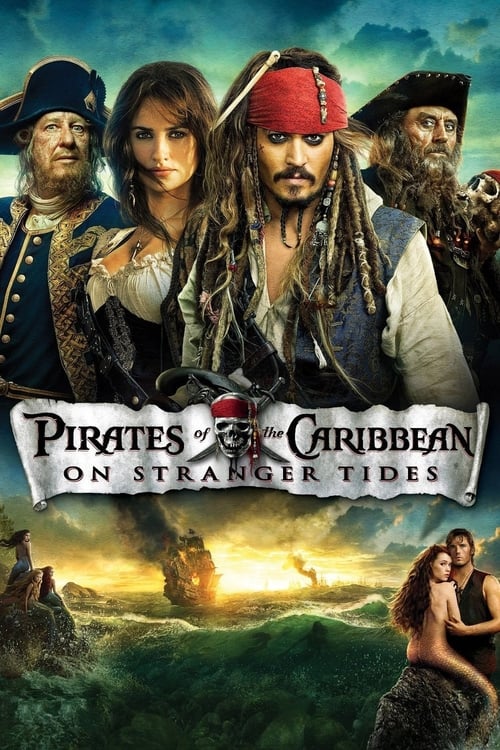
Pirates of the Caribbean: On Stranger Tides (2011)
- Before Johnny Depp was cast, several major A-list stars turned down the lead role because they felt the script was too risky.
- Rob Marshall originally wanted a completely different ending for the film, but test audiences preferred the one we see today.
- The original script for Pirates of the Caribbean: On Stranger Tides was written over a decade before production finally began in 2011.
Pirates of the Caribbean: On Stranger Tides is a 2011 American fantasy adventure film directed by Rob Marshall, the fourth installment in the Pirates of the Caribbean franchise and the first without Orlando Bloom and Keira Knightley. Johnny Depp returns as Captain Jack Sparrow, who is drawn into a race to find the legendary Fountain of Youth alongside the fearsome pirate Blackbeard, played by Ian McShane, Blackbeard's daughter Angelica, played by Penélope Cruz, and Jack's old rival Captain Barbossa, now serving as a privateer for the British Crown. The production represented a deliberate scaling-down of the franchise after the increasingly complex and overlong mythology of the previous two sequels, returning to a more straightforward adventure structure.
Rob Marshall, known primarily for the musical Chicago, brought a different directorial sensibility than Gore Verbinski, with more emphasis on character interaction and less on massive CGI spectacle. Penélope Cruz's addition as a romantic foil for Jack Sparrow brought new energy to the franchise, and Ian McShane's portrayal of Blackbeard as a genuinely menacing figure with supernatural control over his ship added a darker edge. The film's mermaid attack sequence, depicting beautiful but deadly creatures who lure sailors to their doom, was praised as one of the franchise's most creative and frightening set pieces.
On Stranger Tides was filmed extensively in 3D using the same camera system developed for Avatar. The film earned $1.05 billion worldwide, crossing the billion-dollar mark largely on the strength of its international performance, though domestic reception was more modest than previous entries and critical reviews were the franchise's most lukewarm to date.