Yul Brynner
Frequent Collaborators
i How is this score calculated?
The ThumbScore for Yul Brynner (83.3%) is the average audience approval rating across 3 films. Each movie's ThumbScore represents the percentage of real audiences who rated it positively. A higher score means more of Yul's films are well-received by everyday viewers.
Yuliy Borisovich Briner (Russian: Юлий Борисович Бринер; July 11, 1920 – October 10, 1985), known professionally as Yul Brynner (Russian: Юл Бриннер), was a Russian and American actor. He was known for his portrayal of King Mongkut in the Rodgers and Hammerstein stage musical The King and I (1951), for which he won two Tony Awards, and later an Academy Award for Best Actor for the 1956 film adaptation. He played the role 4,625 times on stage, and became known for his shaved head, which he maintained as a personal trademark long after adopting it for The King and I. Considered one of the first Russian-American film stars, he was honored with a ceremony to put his handprints in front of Grauman's Chinese Theatre in Hollywood in 1956.
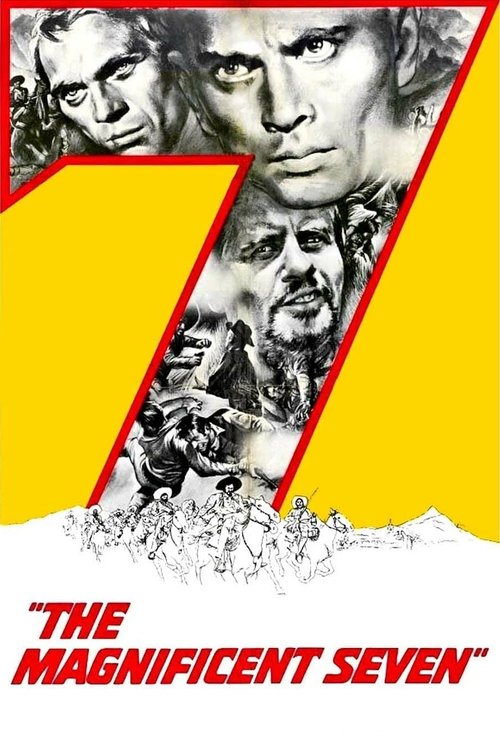
He also received a star on the Hollywood Walk of Fame in 1960. In 1956, Brynner received the National Board of Review Award for Best Actor for his portrayals of Rameses II in the Cecil B. DeMille epic The Ten Commandments and General Bounine in Anastasia. He was also well known as the gunman Chris Adams in The Magnificent Seven (1960) and its first sequel, Return of the Seven (1966).
Brynner made his Broadway stage debut in a production of Shakespeare's Twelfth Night that premiered on December 2, 1941. He appeared as Fabian, a character with only a few lines, as his English was limited and he had a noticeable Russian accent. The job helped him to start adding English to the list of languages he spoke, which included Russian, French, Japanese, and Hungarian. That show, along with many other Broadway productions, closed after the attack on Pearl Harbor, when the United States declared war on Japan, and Nazi Germany declared war on the United States. Soon Brynner found a job as a radio commentator presenting war propaganda in French and Russian at the Voice of America radio station.
He had little acting work during the next few years, but did co-star in a 1946 production of Lute Song with Mary Martin. He also did some modeling work and was photographed nude by George Platt Lynes. In 1944, Brynner married actress Virginia Gilmore. Soon after, he began working as a director at the then-new CBS television studios. In 1948 and 1949, he directed and also appeared on television alongside his wife in the first two seasons of Studio One.
In 1960, he was inducted into the Hollywood Walk of Fame with a motion pictures star at 6162 Hollywood Boulevard.
Born 1920-07-11 in Vladivostok, Russia. Died 1985-10-10.
On ThumbScore, Yul Brynner appears in 3 films with an average audience score of 83.3%, most frequently in the Western genre.